


Performance marketing is advertising you can measure. Instead of paying for exposure and hoping it works, you pay for campaigns that are built around a specific result, such as a lead, a phone call, a booking or a sale, and you track exactly what each dirham brings back.
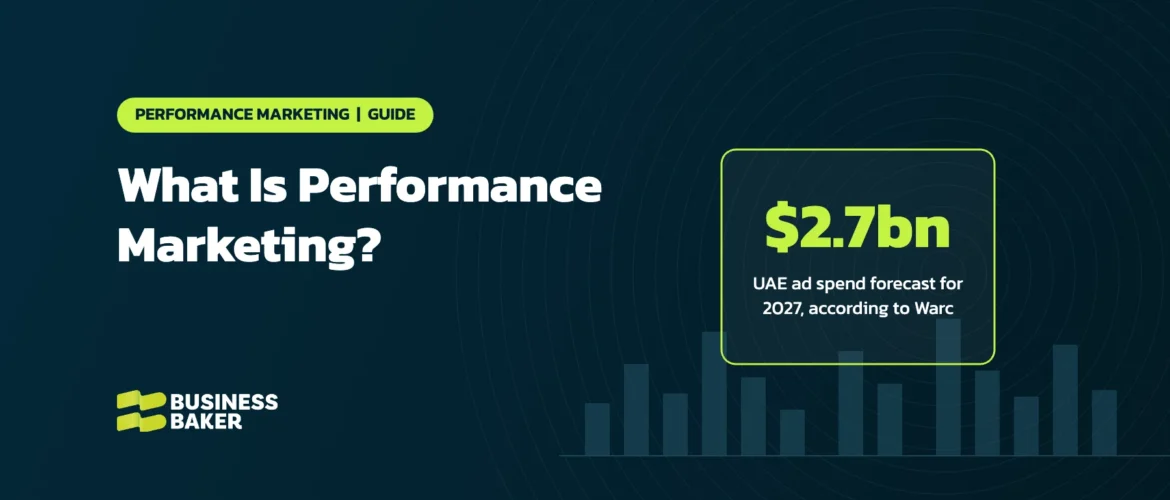
For businesses in Dubai and across the UAE, that matters more every year. According to Warc data reported by AGBI, UAE ad spend reached about $2.15 billion in 2025 and is forecast to reach $2.7 billion by 2027, with digital growth expected to stay above 10% a year. More competition for the same customers means guesswork gets expensive. This guide explains how performance marketing works, which channels and metrics matter, and how to start.
The short answer
Performance marketing is paid digital advertising where success is defined by measurable actions, not impressions. You set a goal and a target cost per result, track every conversion, test what drives it and move budget towards the campaigns that pay back. It runs mainly on Google, Meta (Facebook and Instagram), TikTok, Snapchat, LinkedIn and YouTube.
How performance marketing works
Every performance campaign follows the same loop. The tighter the loop, the faster costs come down.
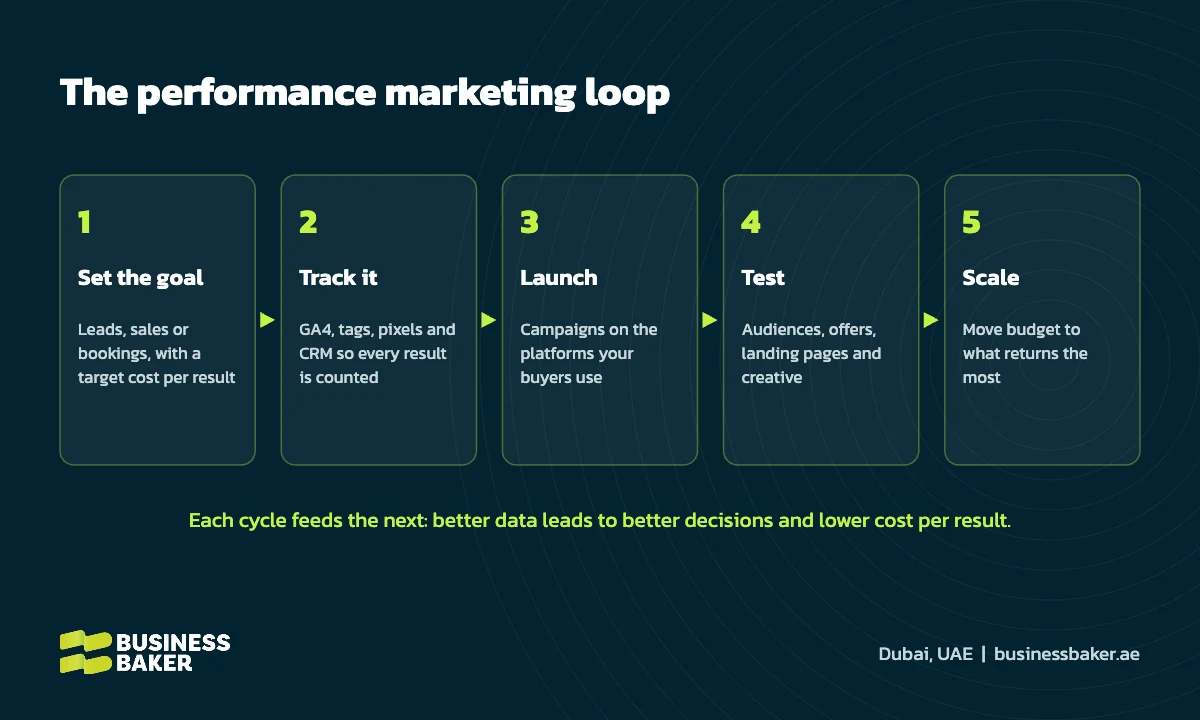
- Set the goal. Decide what a result is (a form, a call, a WhatsApp message, a purchase) and what you can afford to pay for it.
- Track it. Set up GA4, Google Tag Manager, platform pixels and, ideally, your CRM, so every result is counted and attributed to the campaign that drove it.
- Launch. Run campaigns on the platforms where your buyers spend time, with a clear offer and a landing page built to convert.
- Test. Compare audiences, keywords, offers, ad creative and landing pages, and keep what works.
- Scale. Shift budget to the campaigns with the best cost per result, then repeat the loop.
Performance marketing vs brand marketing
| Performance marketing | Brand marketing | |
|---|---|---|
| Main goal | Leads, sales and bookings now | Awareness and preference over time |
| How you pay | Mostly per click, view or result | Mostly per reach or placement |
| How you measure | Cost per lead, cost per acquisition, ROAS | Reach, recall, search demand, share of voice |
| Time to results | Days to weeks | Months to years |
| Best used for | Capturing and converting demand | Creating future demand |
The two work best together. Brand activity makes people more likely to click and buy when they see your performance ads later. Research by Les Binet and Peter Field for the IPA is often summarized as a 60:40 split between brand and activation, but the right balance depends on your category and stage. For most growing UAE businesses, performance comes first because it pays for itself fastest.
The main performance channels in the UAE
The UAE is one of the most connected markets in the world. DataReportal reports internet penetration of about 99%, with large advertising audiences on every major platform.
| Channel | What it is best for | Learn more |
|---|---|---|
| Google Search | Capturing people who are already searching for your service | Google Ads management |
| Meta (Facebook and Instagram) | Lead generation and ecommerce with precise audience targeting | Meta Ads management |
| TikTok | Reaching younger audiences with short, native video | TikTok Ads |
| Snapchat | Strong reach among young UAE and GCC audiences | Snapchat Ads |
| B2B services and senior decision makers | LinkedIn Ads | |
| YouTube | Video that builds demand and retargets visitors | YouTube Ads |
Not sure where to start? Our comparison of Meta Ads vs Google Ads covers the two biggest platforms, and our paid advertising page shows how we combine them.
The metrics that matter
| Metric | What it tells you |
|---|---|
| Cost per click (CPC) | What you pay for each visit from an ad |
| Conversion rate | The share of visitors who take the action you want |
| Cost per lead (CPL) or cost per acquisition (CPA) | What each enquiry or customer costs you |
| Return on ad spend (ROAS) | Revenue generated for every dirham spent on ads |
| Customer acquisition cost (CAC) | The full cost of winning a customer, including fees and production |
| Lifetime value (LTV) | What a customer is worth over the whole relationship |
The most useful single check is simple: is your cost per customer lower than the profit that customer brings? If it is, you can keep spending. Our guide to calculating your ad budget shows how these numbers connect.
What is changing in 2026
- AI runs more of the bidding and targeting. Google reports that advertisers using AI Max for Search campaigns typically see 14% more conversions or conversion value at a similar cost. Meta reported an average 22% improvement in return on ad spend from Advantage+ sales campaigns during 2025, according to PPC Land.
- Data quality decides who wins. When the platforms do the targeting, the advertiser with the best conversion data gets the best results. Feeding real lead quality back from your CRM is now one of the biggest levers available.
- Creative is the new targeting. With audiences increasingly automated, the ad itself decides who sees it and who responds. Regular creative testing matters more than ever.
- Search is changing. AI answers now appear for many searches, so paid search, SEO and GEO need to work together.
Common mistakes to avoid
- Launching without tracking. If conversions are not measured, the platforms cannot optimize and you cannot judge results.
- Judging too early. Most campaigns need a few weeks of data before they settle.
- Chasing cheap clicks. The cheapest traffic often brings the weakest leads. Judge campaigns on cost per customer.
- Sending traffic to a weak page. A slow or unclear landing page wastes even the best campaign.
- Running the same ads for months. Creative fatigue quietly pushes costs up.
Is performance marketing right for your business?
If you sell a product or service people search for or buy online, and you can measure enquiries or sales, performance marketing is usually the fastest way to grow. It works best when you know your margins, can respond to leads quickly and are willing to test. To see how it can grow your business beyond the first campaigns, read how performance marketing helps you scale, and when you are ready to bring in help, our guide to choosing a performance marketing agency in Dubai explains what to look for.
Frequently asked questions
What is performance marketing in simple terms?
Performance marketing is paid advertising where every campaign is tied to a measurable action, such as a lead, a call, a booking or a sale. You track what each dirham returns and move budget towards what works.
Is performance marketing the same as digital marketing?
No. Digital marketing is the wider umbrella that includes SEO, social media management, content and email. Performance marketing is the part focused on paid campaigns with measurable outcomes, mainly on platforms like Google, Meta, TikTok, Snapchat, LinkedIn and YouTube.
How much budget do I need to start performance marketing in the UAE?
It depends on your industry, the platform and the number of leads you need. Most businesses start with a test budget on one or two platforms for four to eight weeks, then scale what works. Our free ad budget calculator gives you an approximate starting point in AED.
How long does performance marketing take to work?
Search ads can bring enquiries on the first day. Most campaigns need two to eight weeks of data before targeting, bidding and creative are properly optimized, and results usually keep improving after that.
Which metrics matter most in performance marketing?
Focus on business outcomes: cost per lead or cost per acquisition, conversion rate, return on ad spend and, where possible, lead quality and revenue from your CRM. Clicks and impressions are useful diagnostics but not goals in themselves.
Sources
- AGBI, “Ad spend in Gulf growing quicker than rest of world”, citing Warc (October 2025).
- DataReportal, Digital 2026: The United Arab Emirates.
- Google, AI Max for Search campaigns (May 2025).
- PPC Land, Meta Q4 2025 advertising results (January 2026).
- IPA, The Long and the Short of It.